
Have you ever studied a chapter thoroughly, understood every concept, and felt completely prepared - only to forget most of it a few days later?
It is one of the most frustrating experiences for students. You spend hours reading, highlighting, rewriting notes, or watching explanations. Everything seems clear at the time. Then, when the exam arrives, the information suddenly feels difficult to retrieve.
This does not always mean you studied badly or lack the ability to learn. Forgetting is a natural part of how memory works. The real challenge is understanding why information fades and using learning methods that help the brain retain and retrieve it more effectively.Why Do Students Forget What They Study?
1. The Brain Does Not Keep Everything
Every day, the brain receives an enormous amount of information. Conversations, lessons, notifications, videos, instructions, names, facts, and experiences all compete for attention.
If the brain treated every piece of information as equally important, it would quickly become overwhelmed. So information that is not revisited, used, connected, or retrieved may gradually become harder to remember.
This is why understanding something once does not guarantee that you will remember it later.2. Rereading Creates Familiarity, Not Always Memory
One of the most common study methods is rereading.
A student reads a chapter once. Then again. By the third reading, the content feels familiar. This familiarity can create the impression that the material has been learned.
But there is an important difference between:
“I recognize this when I see it.”
and
“I can explain this without looking at the page.”
The second is a much stronger test of learning.
Instead of repeatedly rereading the same material, students should regularly close the book and try to recall the main ideas from memory.3. Cramming Stores Information for the Short Term
Studying everything the night before an exam can sometimes help students remember information temporarily. The problem is that much of it may disappear soon after the test.
Cramming gives the brain very little opportunity to revisit and strengthen the information over time.
A more effective approach is to spread learning across several days or weeks. Revisiting a topic at intervals helps reinforce memory and makes future recall easier.
For example, instead of studying one chapter for three hours on Sunday, a student could review it for shorter periods on Sunday, Tuesday, Friday, and the following week.
The total study time may be similar, but the learning experience is very different.

4. Passive Learning Feels Easier Than Active Learning
Many students spend hours:
highlighting textbooks
copying notes
watching educational videos
reading summaries
listening to lectures
These activities can support learning, but they become less effective when students only receive information without doing anything with it.
Learning becomes stronger when students actively interact with the material.
That could mean:
answering questions without notes
solving problems independently
explaining a concept aloud
creating examples
comparing two ideas
writing what they remember before checking the textbook
5. New Information Has Nothing to Connect To
The brain remembers ideas more easily when they are connected to something meaningful.
Imagine trying to memorize ten random words. Now imagine learning ten words connected through a story. The second task is usually easier because the information has structure and relationships.
The same principle applies to academic learning.
When studying a new concept, ask:
What does this remind me of?
Where have I seen this before?
How is this different from something I already know?
Can I connect this to a real-life example?
Why does this concept matter?
6. Students Mistake Understanding for Mastery
A teacher explains a difficult concept clearly. The student follows every step and thinks:
“Yes, I understand this.”
But later, when trying the same problem alone, the student gets stuck.
Why?
Because following an explanation is different from independently producing an answer.
Understanding is an important first step. Mastery requires students to use the knowledge without depending heavily on notes, teachers, videos, or worked examples.
A simple test is:
Can I explain or apply this without looking at the answer?
If not, the topic probably needs more practice.How to Make Learning Stick
1. Use Active Recall
Active recall means deliberately trying to retrieve information from memory.
After studying a topic, close the book and ask yourself:
What were the three main ideas?
Can I define the key terms?
Can I explain the process in order?
What examples can I remember?
Which part am I unable to explain?
You can practice active recall using:
flashcards
practice questions
blank-page summaries
self-quizzes
verbal explanations
2. Space Out Your Revision
Instead of revising a topic repeatedly in one sitting, return to it after increasing intervals.
A simple revision pattern could look like this:
First review: the same day
Second review: two days later
Third review: one week later
Fourth review: two weeks later
Fifth review: one month later
The exact schedule can vary depending on the subject, difficulty level, and exam timeline. What matters is revisiting the material before it becomes completely unfamiliar.
3. Explain It Like You Are Teaching Someone
Teaching forces you to organize your thoughts.
Choose a concept and explain it as if you were teaching:
a younger student
a classmate
a parent
someone with no knowledge of the subject
Avoid simply repeating textbook definitions. Use your own words.
If you become confused halfway through the explanation, you have discovered a gap in your understanding. Return to the material, clarify that gap, and try again.4. Mix Different Types of Questions
Practicing the same type of question repeatedly can make students feel confident because they know what method to use.
Real exams are rarely that predictable.
Mixing different topics and question types forces the brain to decide:
What is this question asking?
Which concept applies here?
Which method should I use?
How is this different from the previous problem?
5. Connect Learning to Real Life
Abstract information becomes easier to remember when it has meaning.
For example:
connect percentages to discounts and budgeting
connect statistics to sports or social media data
connect science concepts to everyday observations
connect language vocabulary to real conversations
connect business concepts to familiar companies
6. Review Mistakes Instead of Hiding Them
Students often feel uncomfortable looking at incorrect answers. But mistakes can reveal exactly where learning needs improvement.
After a test or practice session, ask:
Why did I get this wrong?
Did I misunderstand the concept?
Did I forget a step?
Did I misread the question?
Did I know the answer but fail to retrieve it?
Have I made this mistake before?
7. Protect Sleep and Attention
Memory is not only about study techniques.
Sleep, stress, distractions, and attention all influence learning.
Studying while constantly switching between notes, messages, short videos, and notifications can reduce the depth of attention given to the material. Similarly, consistently sacrificing sleep for late-night study sessions may work against effective learning.
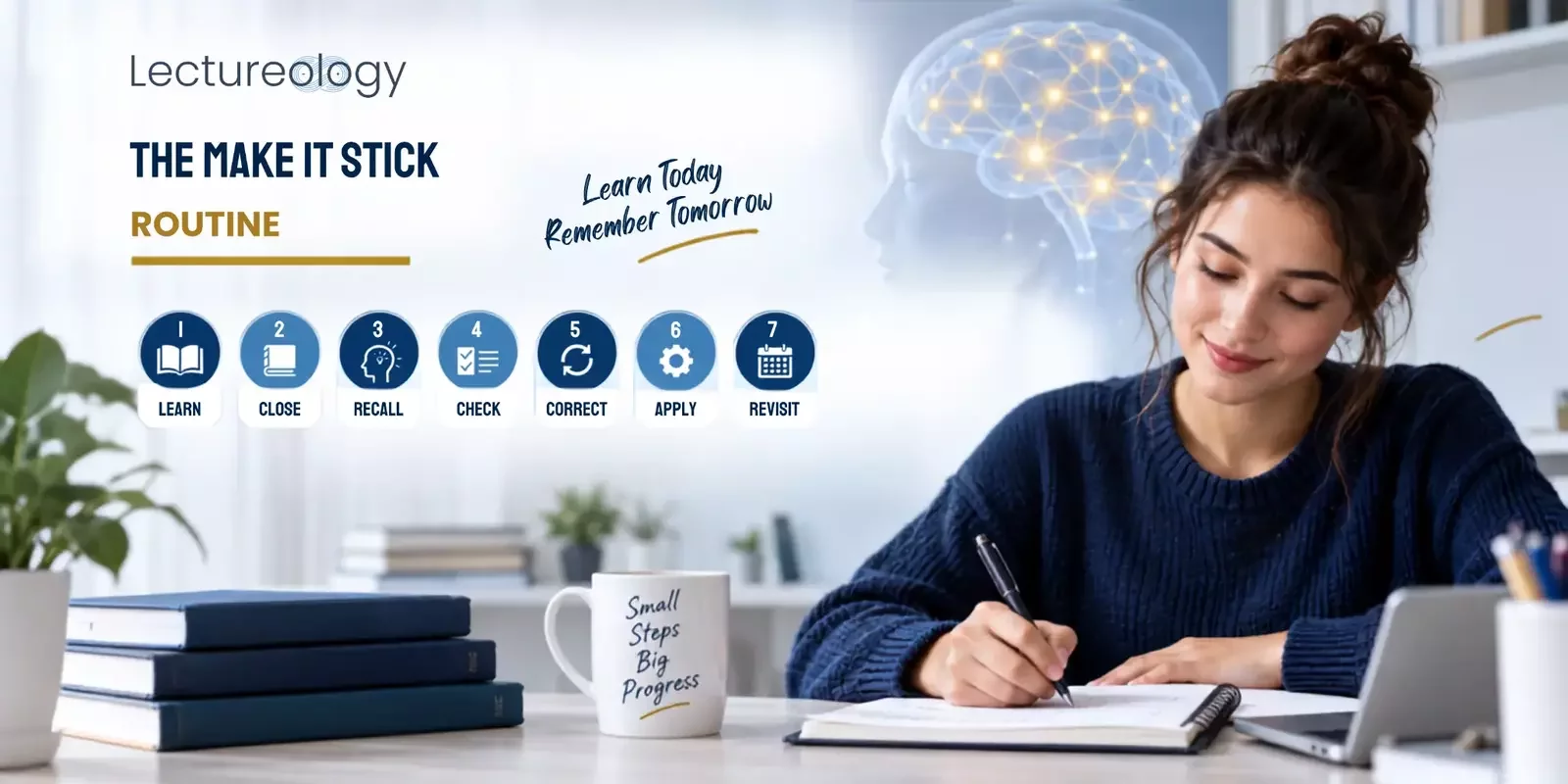
Students do not need perfect routines. But focused study periods, regular breaks, and sufficient rest can create better conditions for memory.A Simple “Make It Stick” Study Routine
Students can try this approach after learning a new topic:
Step 1: Learn
Read, watch, or listen to the explanation carefully.
Step 2: Close
Put away the textbook or notes.
Step 3: Recall
Write or say everything you remember.
Step 4: Check
Compare your answer with the original material.
Step 5: Correct
Focus on what you missed or misunderstood.
Step 6: Apply
Answer a question or solve a problem using the concept.
Step 7: Revisit
Return to the topic after a few days.
Final Thoughts
Forgetting is not always a sign that a student is bad at studying. Often, it is a sign that the information was encountered but not sufficiently retrieved, applied, connected, or revisited.
The solution is not necessarily to study for more hours.
It is to study in ways that require the brain to actively work with information.
Instead of asking:
“How many times did I read this?”
ask:
“Can I recall it, explain it, connect it, and use it without looking?”
That shift can make the difference between information that feels familiar today and learning that remains accessible when it actually matters.