
Fix their skills, their career direction, their confidence, their future
And for a few days, maybe even weeks, it feels true.
You watch the videos.
You take notes.
You feel productive.
But then something shifts.
The tabs stay open, but untouched.
The lessons get bookmarked “for later.”
And slowly, what started as motivation turns into another unfinished course sitting in your dashboard.
So no, online courses don’t work.
Not on their own.
The Problem Isn’t the Course
It’s easy to mistake watching for learning.
Easy to confuse understanding with ability.
You finish a module and think, “Yeah, I get it.”
But when it’s time to actually do something with it, things feel… unclear.
That’s where most people stop.
What Actually Makes It Work
- Not jumping to the next video just because this one ended
- Not using completion percentage as your measure of progress
- Not assuming notes = learning
Instead, you slow down a bit.
You pause.
You try it yourself.
You mess up.
You figure it out.
That’s the part most people skip.
And that’s exactly the part that matters.

If This Sounds Abstract, It’s Not
They did something with what they learned.
What This Looks Like for You
This doesn’t mean you need to build something huge right away.
It can be simple.
- If you’re learning coding, build something small (even if it’s messy)
- If you’re learning a concept, explain it in your own words
- If you’re learning a process, repeat it until it feels natural
It might feel slower.
But it sticks.
And that’s the whole point
Why Most People Don’t Do This
Because it is slower.
And in a world where everything is optimized for speed - fast courses, quick results, instant access, slowing down feels like falling behind.
But here’s the irony:
Rushing through five courses and not being able to use any of them doesn’t move you forward.
Spending time on one skill and actually becoming good at it does.
Where Lectureology Academy Fits In
That means learning that goes beyond watching.
It focuses on:
- Practical exposure alongside concepts
- Real-world scenarios instead of just theory
- Building confidence through doing, not just understanding
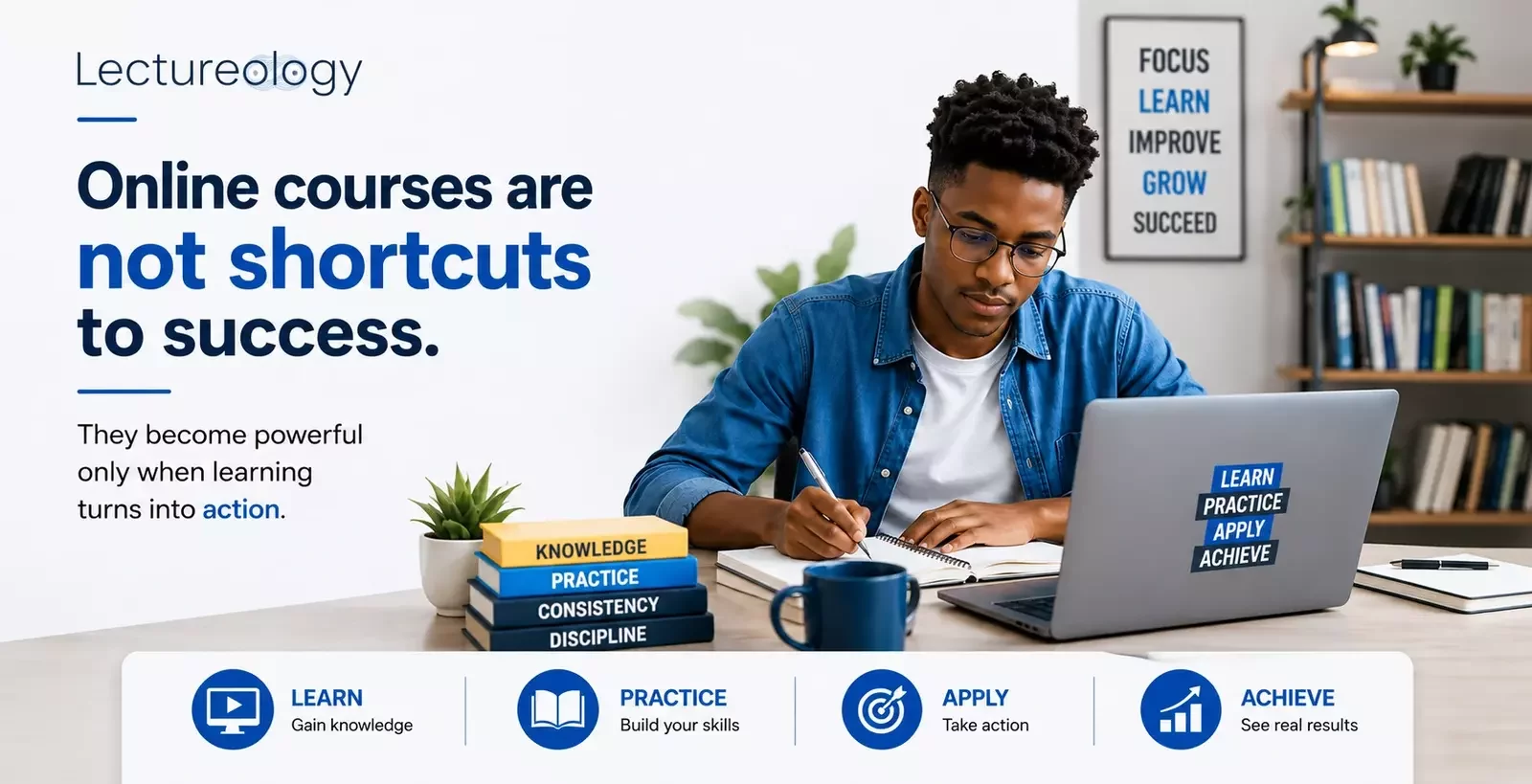
The Real Reason Some People Get Results (and Others Don’t)
It’s not about intelligence.
It’s not about having more time.
It’s not even about choosing the “perfect” course.
It’s about involvement.
- Engage actively instead of passively consuming
- Practice even when it feels repetitive
- Stay with a concept until it clicks
They work through it.
Final Thought
They’re tools.
It’s, “Am I using this well enough to actually grow?”