What you enjoy doing in your free time could be teaching you skills that your future career needs.
When we think about career development, we usually think about degrees, certifications, internships, and professional experience.
But what if some of the skills that could help your career are already hiding in your hobbies?
Reading, photography, gaming, writing, sports, cooking, creating videos, volunteering, or even managing a social media page may seem unrelated to your future career. Yet hobbies often help us develop skills naturally because we're willing to spend time practicing something we genuinely enjoy.
The key is learning how to recognize those skills and turn them into something you can use professionally.Your Hobby May Already Be Building Skills
Consider someone who runs a small book-focused Instagram page as a hobby.
They may think they're simply sharing something they love. But along the way, they could be learning content creation, copywriting, photography, audience engagement, consistency, basic analytics, and social media strategy.
Someone who plays team sports may be developing communication, leadership, teamwork, discipline, and decision-making.
A person who enjoys photography may be developing visual storytelling, attention to detail, creativity, and editing skills.
The hobby is only the starting point. The professional value comes from identifying what you're actually learning through it.Step 1: Identify the Skill Behind the Hobby
Ask yourself:
What do I actually do when I'm pursuing this hobby?
If you enjoy writing stories, you may be developing storytelling and communication.
If you make videos, you may be learning scripting, editing, presentation, and content strategy.
If you play chess, you may be strengthening strategic thinking and patience.
If you organize events with friends, you may be developing planning, coordination, communication, and problem-solving.
Don't focus only on the activity itself. Look at the skills you're repeatedly practicing.Step 2: Practice With Intention
Doing something for fun and developing it as a professional skill aren't always the same thing.
Once you've identified the skill, start practicing it deliberately.
If you enjoy photography, learn composition and editing instead of simply taking random pictures.
If you enjoy writing, experiment with different formats such as blogs, scripts, newsletters, or social media content.
If you enjoy video creation, learn storytelling, editing, sound, and audience retention.
You don't have to turn your hobby into a job immediately. Simply becoming more intentional about your learning can make the skill much stronger.
Step 3: Create Something You Can Show
One of the biggest advantages of turning a hobby into a professional skill is the opportunity to build a portfolio.
A portfolio gives employers something tangible to evaluate.
If you enjoy writing, create a collection of your best articles.
If you're interested in graphic design, create sample designs.
If you enjoy photography, build a photography portfolio.
If you create content, document your best videos or campaigns.
Your personal projects can demonstrate your abilities even when you don't have years of professional experience.Step 4: Look for the Connection to Your Career
Your hobby doesn't necessarily need to become your full-time career.
Instead, ask:
Where could this skill be useful professionally?
A person who loves gaming might have strong problem-solving and strategic thinking skills.
Someone who enjoys theater may have excellent presentation and communication abilities.
A photography hobby could support a career in marketing or content creation.
A passion for languages could open opportunities in education, tourism, customer relations, or international business.
The goal is to find the bridge between what you enjoy and what organizations need.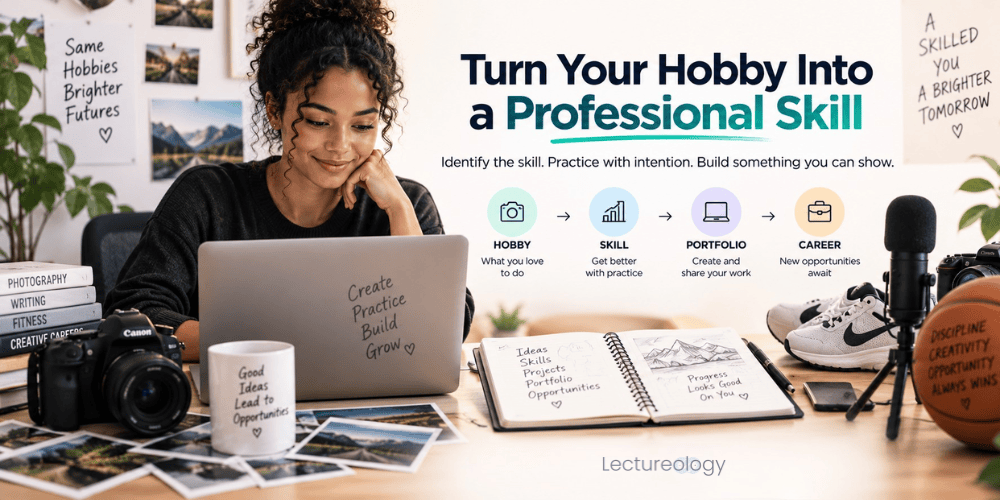
Step 5: Take Your Skill Beyond Your Comfort Zone
Once you've developed some confidence, look for opportunities to use your skill outside your personal projects.
Volunteer to create content for an organization. Participate in competitions. Take freelance projects. Join a college club. Help a small business. Collaborate with other creators.
Real-world experience teaches you things that personal practice cannot.
You learn how to work with deadlines, receive feedback, communicate with others, and adapt your work to someone else's expectations.Step 6: Add Structure Through Courses and Certifications
A hobby can give you practical experience, but structured learning can help you fill the gaps.
You might already know how to create videos, for example, but a course could teach you storytelling principles, editing techniques, content strategy, or professional workflows.
Similarly, someone interested in languages could combine personal practice with a structured language course or certification.
The combination of interest + practice + structured learning can turn a casual hobby into a much stronger skill.Don't Feel Like You Have to Monetize Everything
There's an important distinction between developing a hobby and turning it into a career.
Not every hobby needs to become a source of income.
Sometimes, a hobby should simply remain something you enjoy.
The goal isn't to turn every passion into a side hustle. It's to recognize when something you genuinely enjoy is also helping you develop skills that could benefit your professional life.
You can keep the joy while still learning from the experience.Your Hobby Could Give You an Unexpected Advantage
Imagine two candidates applying for a content-related position.
Both have similar degrees. But one has spent two years running a personal blog, experimenting with videos, studying audience engagement, and building a portfolio.
That experience may not have come from a formal job—but it demonstrates curiosity, initiative, consistency, and practical skill.
This is why personal projects and hobbies can become valuable additions to a professional profile.
They show employers what you choose to do when nobody is making you do it.Final Thoughts
Your career doesn't have to be built entirely from classrooms and workplaces.
Sometimes, it starts with something you do simply because you enjoy it.
The books you read, the videos you create, the games you play, the photographs you take, the sports you practice, or the communities you participate in may already be helping you develop valuable skills.
The next step is to recognize those skills, practice them intentionally, and find opportunities to apply them.
At Lectureology Academy, we believe learning can happen anywhere. A hobby can spark curiosity, curiosity can lead to learning, and learning can eventually become a skill that opens new opportunities.
So take another look at what you love doing.
Your next career skill might already be hiding in your free time.